This Thursday, spread across different parts of the municipality, we will be able to admire the Compadres. Currently, most are made almost life-size, with old clothes and paper fillings. For the faces, photos of men – or women in the case of the Comadres – from the parish, association or organization (the Day Center, the school, etc.) where they were made. Normally, they represent some action or scene, and accompanied by written posters, they can make some criticism or social commentary.
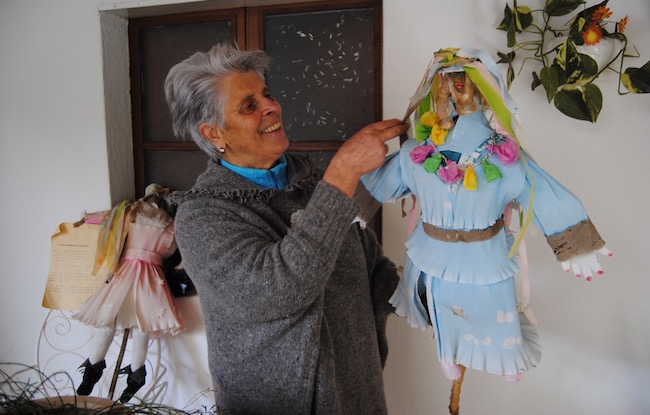
However, traditionally, compadres and comadres were different. To remember them, we spoke with Clarita of Basque Country, a native of Salcedo, a parish of carnivalistas par excellence. ‘In our house we were always very carnival-loving... And my grandmother was terrible... terrible! Here everyone.’
Clarita has been making these figures in the traditional way for a long time, and continued while her grandson was little, making the comadres with which they won the Xoves de Comadres competition in Monforte year after year.

Clarita tells us that the compadres and comadres were made on a wooden cross. The arms and legs were made of straw. And the chest, ass and belly were stuffed with paper. Newspaper paper that the priest and the teacher would take from where they kept the newspapers, “which was where the newspapers were,” says Clarita. And if there was no paper, they were made entirely of straw, like in the old days.
After having the body, the clothes were made with papers, and a turnip or a beet for the head, on which the face was painted. In the compadres, Clarita recalls, ‘with charcoal, the moustache was painted... That could not be missing... A good mustache!’.
The girls and women would get together at night to make the figures and then, on Compadres Thursday, they would hide them from the boys. The girls' goal was to burn them, and the boys' goal was to catch them to prevent them from being burned.
Clarita remembers all kinds of strategies that were invented: tying Compadre under the table (‘and they entered the house to take him!’), to catch a Compadre through a window with a gallows, hiding it under the jacket to take it to be burned… ‘[The men] distrusted everyone! Because there were so many young people back then… Wherever they saw a woman going out, that woman was already being watched… to see where she was going and what she was wearing…’ says Clarita.
The compadres who were not saved ended up in the fire. And when they burned, ‘the bells rang’, says Clarita, and they screamed ‘Let the Compadres burn! And long live the Comadres! what they were burning! What they were burning the pigs! What they were burning the pigs!’
On Comadres Thursday, the same thing happened: the young men would make the comadres (with the help of the older women) and then the young women would run after them to catch them and avoid burning them. Although Clarita remembers that the comadres ‘respected each other a lot... People would applaud when they passed by with them’.


Clarita won't be doing a traditional compadre this year, but we'll probably see one in the current style. And who knows, maybe we'll even get to see Clarita herself as a comadre. ‘Pichón always told me: “I'm so pissed off! You've been doing compadres for so many years. One year we'll do it for you and you'll see how we're going to make you!”, but they never did it for me…’ But to see if it's the case this year, we'll have to wait until next week, until Comadres Thursday.