On the Day of Calero Oak
By Xurxo Ayan
That night in September 1936, kilometer 52 of the old road from A Pobra do Brollón to Quiroga became Mount Gólgota, which in Aramaic means “place of execution”. There they found the bodies of Odilo the carpenter, a stranger and Don Juan, national teacher of Vilachá, laid out on biers. The official who posed as a person in the uprising noted in the death certificate the teacher’s elegant attire: white shirt, blue tie, white and red pins, grey ankle boots, light belt and a handkerchief in his pocket with the initials JA, letters embroidered with the affection of a mother or a lover. This crime, and hundreds of others like it, were illustrated by Castelao in his eternal painting “The Last Lesson of the Teacher”.
Fascism tried to eliminate those teachers who, from schools, institutes and universities, believed in the redemptive power of knowledge and fought for social justice through the socialization of knowledge. Those who did not end up in a ditch were sent to prison and to labor camps to later be disqualified, forced not to exercise their profession, their teaching, in the miserable times of the post-war period, in the years of famine. There are two philologists, two lovers of the word, who sum up the fascist madness in their downfall: Aníbal Otero Álvarez (1911-1974) and Ricardo Carvalho Calero (1910-1990).
Aníbal's work has been masterfully analyzed in a wonderful biography by Professor Xesús Alonso Montero. Aníbal Otero was a philology student, born in Ribeira de Piquín, who in Madrid joined the project to prepare the Linguistic Atlas of the Iberian Peninsula within the framework of the Center for Historical Studies under the leadership of Ramón Menéndez Pidal. Aníbal did an excellent job traveling through Galicia in the pre-war years with his beautiful surveys, such as that of that countryman who differentiates the Moors from the Moors, because the latter are the keepers of treasures and the others are not, or that riverside man who points out the difference between “islas” and “illas”: the islas are those that are far away and the islands are those that are close by. In July 1936 he finds himself interviewing peasants in the Portuguese region of Minho and there he is arrested by the Portuguese police. The fact of driving a car with the coat of arms of the Spanish Republic had already aroused suspicion, but what really complicated his life were his notebooks with strange signs, like a coded language. It was nothing more than the phonetic transcription of the words collected with a scientific method. There was no doubt. He was a “red” spy. Kidnapped and transferred to the rebel soldiers in Tui, he miraculously escaped the death penalty and was sentenced to four years in prison, which he spent in San Simón and Figueirido, among other prisons. Even in that prison context, witnesses remember a Aníbal with his notebook collecting romances and words from Galician, Bercian and Asturian prisoners. He would do the same shortly before his death when all this traumatic past materialized in a strong depression that led him to be admitted for a while to a sanatorium in Compostela. Even there, sick, he continued to research the words of other colleagues in the clinic, with his eternal notebook. This wise linguist, the best in Galicia for decades, saw his academic career cut short by fascism and returned to his native village where he was a true “telluric farmer” who occasionally published scientific articles here and there. The first volume of the Atlas, a republican project appropriated by Francoism, was published in the early 1960s with the unique contribution of that scientific photographer of rural and seafaring Galicia in the pre-war period, Aníbal Otero, the spy of our language, of our identity.
And now we come to Don Ricardo, a fellow generational student of Aníbal. Carvalho Calero had, among others, two virtues: like the teacher of Vilachá, he had and cultivated a proverbial natural elegance, which made him flee from muddy polemics and, on the other hand, he showed off an enviable ideological coherence. He was always where he considered he should be and that field was none other than Galician nationalism. He was in all the trenches, as a student leader in the FUE (University School Federation), as an active member of the Galician Studies Seminar and as an armed defender of the Republic. The civil war surprised him in Madrid when he was preparing the famous oppositions of 1936, the same ones that Josefina Prol, the teacher of Cereixa for many years, had presented. Ricardo is one of those Galicians (masonry workers, workers, intellectuals, miners) who join the militias to defend the capital in the autumn of 1936. His training is valuable and he ends the conflict with the rank of lieutenant in the Popular Army. He had to pay for his commitment with the death penalty, commuted to years of imprisonment and disqualification from public office. The trauma of the war was so great that he was not able to put his experience in writing until 1987, when he published the novel “Scórpio”, awarded the Galician Narrative Critics Award. He would die in 1990.
Many Republican teachers and professors survived in New Spain by teaching classes almost clandestinely, in private academies and institutes, or by setting up schools at home, as Don Esteban Quiñones did in Nogueiras. Ricardo never lost his decency and gift of teaching, and recovered the gift at the Fingoi school in Lugo, a bastion of cultural Galicianism within the Roman wall. Even so, in the hardest years he insisted on the language, a way of “signifying himself” that could only bring him more problems. Others in much more comfortable situations acted like those who hear the rain. His novel “Xente da Barreira” is the first published in Galician during the Franco regime (1951).
The liberalizing winds that came with the 25th Years of Peace in the 1960s allowed the rehabilitation of teachers who had been reprisaled. In turn, the Press Law opened up a new playing field for publishing in vernacular languages. The new Education Law of 1970 was also decisive, which created the EXB and the current school group of A Pobra do Brollón in Outeiro that we all know. This new framework allowed the learning of what they called “native languages” in the infant school cycles. This entire context is what partly explains Carvalho Calero’s prolific work in favor of the dignity of Galician through historical philology, linguistics and the didactics of the language.
My best gift for this confined Day of Letters is the library of my father Xulio (1946-2014), philologist, professor of literature, theater and Galician. After winning the position, he became a professor in the mid-1970s at the Instituto Masculino de Lugo. His training was greatly influenced by the figure of his classmate, Xesús Alonso Montero. Of all my father's books and brochures, I bring here two pieces to illustrate the scope of the research developed by Carvalho Calero. In December 1971, a Didactic Exhibition of Hispanic Linguistics was organized at the Masculino de Lugo, something totally innovative, by a group of professors, led by Alonso Montero and helped by Ánxel Fole. The students of COU (treaties of Don and Dona) collaborated in this historical exhibition in which the multicultural reality of the Iberian Peninsula was shown. The visitor discovered the literary tradition of Mozarabic, Aranese, Aragonese, discovered the existence of a radio method for learning Basque and, of course, accessed the literary history of Galician. Research works on Galician by Luis Luciano Bonaparte (nephew of Napoleon), the Nazi Krüger and the reprisals of Aníbal Otero and Carballo Calero shared the spotlight.


On another occasion, it included two surveys among students, a questionnaire that is still used today: what are the most beautiful or suggestive words in the Galician language? The chosen words were morriña, mjociso, saudade, enxebre, volvoreta, meiga, agarimo, anduriña and muiñeira. You see, all of them are names of portals in apartment buildings in any Galician city, with neighbors who do not speak Galician or are crazy. And, what are the most beautiful or suggestive words in the Spanish language? In this case, the following came out on top (pay attention to the last one): amor, libertad, paz, amistad, justicia, felicidad, casa, nostalgia, mariposa and aprobado.
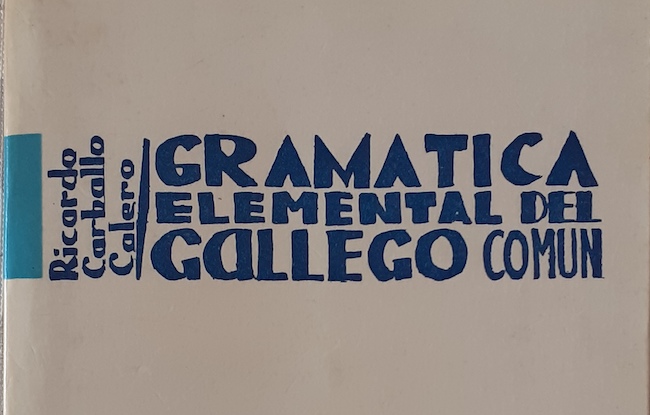
This exhibition was based on the monumental research carried out by Carvalho Calero in the 1960s with the aim of providing the language with basic tools such as a contemporary literature manual or a grammar: “Gramática Elemental del Gallego Común” (Galaxia, 1966). My father kept the second edition (1968) of this book like gold in a cloth. At the time, he was studying the last years of Romances in Barcelona. He had emigrated to Catalonia with his parents when he was nine years old. Every summer he returned to Chavaga, where he would return to the language and the rural world of his childhood. The wonderful thing about the books in his library is that they allow me to make chronostratigraphies, thanks to the memories found between the pages. In this copy of Calero's grammar we find a print from the Campostelano Year of 1970 (it was Jacobean) and a handwritten page with Xulio's handwriting. At the time, my father was 24 years old. On that notebook sheet, squared, Dad copied the lyrics of two songs: “O Tren” and “Miña Maruxa”. They had been composed by Andrés do Barro who that same year achieved fame with his album “O tren” (1969). It was the first time that a song in Galician topped the charts in Spain.


That Romance student, born in the Habanera house in Ríos, Chavaga, not only loved the word, he also had a girlfriend in Cereixa, a blonde girl, the Maruxa from the song by Andrés do Barro. Love, pop and linguistics were the core, the sap and the crust of the revaluation of the Galician language. In the first stanza of Miña Maruxa: “When you left me/my heart began to die/I became a valdeiro because of so many things/that life tells you”, next to the verb “fiquei”, Xulio, with philological intent and much love, pointed out that fiquei meant “I remained empty”.
You see I'm dying of love,
I can't live without you.
You see, I have a dream, my dear.
that one day you come back, you come back to me.
In those days of youth, my father's love for Galician came through Eloína, the festive popular music of Andrés do Barro and the intelligent grammar of Carvalho Calero.