- The campaign is funded by the Xunta de Galicia and has the collaboration of the City Council of A Pobra do Brollón, the Neighborhood Association and the Community of Montes de Salcedo.
- The aim of the campaign is to try to learn more about the functionality of the site
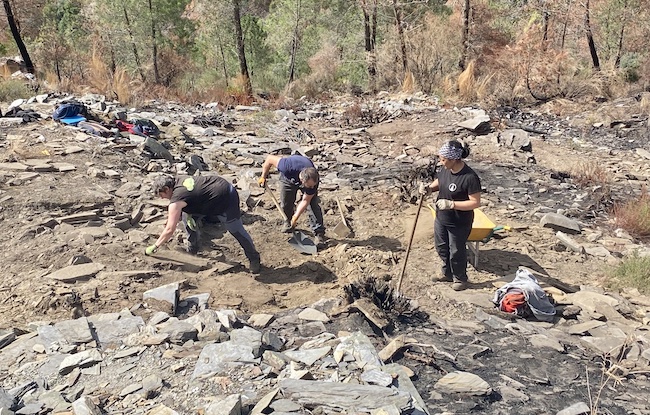
The second excavation is already underway in Penas do Castelo, Salcedo, A Pobra do Brollón. The campaign began with the visit on Monday noon of the territorial delegate of the Xunta de Galicia in Lugo, Javier Arias, together with the mayor of A Pobra do Brollón, Xosé Lois Maceda, the president of the Montes de Salcedo Community, Teddy López, as well as representatives of the Neighborhood Association.
The second excavation in Penas do Castelo begins after the dates achieved in the campaign promoted by the Xunta de Galicia last summer were presented in December and were tremendously surprising due to their antiquity.
In the first campaign, the work focused on the wall area, revealing a construction system with truly original solutions and a monumental appearance. Several samples were taken to date the wall by Carbon-14 and therein lay the surprise: a dating of the 9th century BC at the oldest dating end.
In this way, what was not known whether it was a hillfort or an early medieval castle, turned out to be one of the oldest castros in the northwest of the peninsula, right at the beginning of the appearance of this type of permanent settlements. “We are in a period of transition between the Bronze Age and the Iron Age, a complex one,” says the director of the intervention, Benito Vilas de Árbore Arqueoloġija.

After the when, the why
There is still much to learn about the site, hence this second excavation campaign. “Once we have the when, we want to know the why,” says Vilas. There is a hypothesis that the site is linked to the exploitation of minerals, probably iron, both due to the richness of the surroundings and the fact that the little material that has appeared is slag resulting from mineral reduction work.
This year's surveys aim to find more evidence of the activities that were carried out at the site. “The site is in an almost inaccessible and steep place, there had to be something of great importance that led to its establishment in such an inhospitable place.”.
For the final choice of the polls of this campaign, fire was decisive. The site burned in the fire that affected Pobra do Brollón and Folgoso do Courel in July. “The fire passed through it quickly and did not affect the structures,” says Benito. However, it eliminated the existing vegetation, allowing new structures to be detected and refining the location of the surveys.
Establishing a “Village Archaeology”
The excavation is part of a neighborhood project that aims to enhance the heritage of the parish, known for the Salcedo Bear Carnival. In this way, last week the Salcedo Cultural Week was celebrated, which had already been recovered last year and is linked to the cultural and associative past of the parish.
In fact, one of the activities was the magazine's vindication The Voice of Salcedo, a magazine published by the Neighborhood Association. In addition, there were two talks in the village canteens, a night walk with stargazing and a choral concert by the musician Ale, a resident of Salcedo, together with friends and family from the parish.
“The essence of the project is the community character, that people connect and create a circle around the heritage elements,” says Marisa Defente, from the board of directors of the Salcedo AV and the Comunidade de Montes de Salcedo.
Throughout September, more informative and Heritage-related activities are planned, which will be revealed little by little.
The project is also included in the municipal heritage policy that is firmly committed to archaeology in the Community as a way of managing its Heritage. Projects such as the Castro de San Lourenzo in Cereixa, Adegas da Memoria in Vilachá or Penas do Castelo in Salcedo, are examples of how to establish tourist resources in a sustainable way and hand in hand with the local community.
On the other hand, The Ministry of Culture also points out the importance of this type of community projects for transversal management of Heritage.. Furthermore, they highlight how Penas do Castelo is in a strategic location, a hinge between the Ribeira Sacra and the Courel, in the symbolic center of the Ribeira Sacra-Courel Biosphere Reserve.
In the current situation, after the devastating fire that ravaged the area at the beginning of summer, recovering alternative activities in the forest is essential.