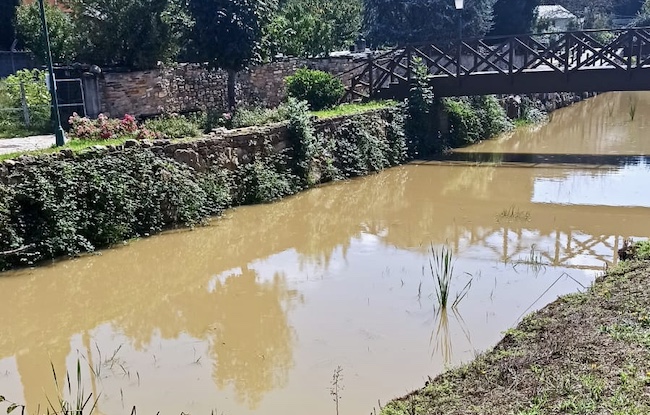
- The rivers that supply most of the houses in the municipality are full of mud due to the combination of torrential rains and the state of the mountains after last year's fires.
- Mayor Xosé Lois Maceda is in talks with different institutions to find solutions
- The City Council will offer a water distribution service to the affected parishes
The torrential rains of recent days, combined with the state of the forest after last year's fires and the consequent removal of wood, have caused landslides that are filling the Loureiro and Lor rivers with mud, which supply water to a large part of the municipality of A Pobra do Brollón.
Given this situation, the City Council of A Pobra do Brollón was forced to issue two sides in which it is recommended, until further notice, not to consume tap water in the areas of Barxa de Lor, Pereiro, Domiz, Recemunde, Tudriz, Martul, Vilardeperas, Lamaigrexa, Castroncelos, Vilarmao, Piñeiros, A Estación, Cereixa, Abrence, Frieira, Pinel and A Pobra do Brollón. Eixón and Fornelas were also indicated, but are currently no longer affected areas.
Our municipality is the victim of a situation resulting from a serious environmental crisis caused by the large fires experienced last summer,’ declares the mayor of A Pobra do Brollón, Xosé Lois Maceda. ‘It is foreseeable that in the coming days, with the rain subsiding, the state of the water will improve; but this situation will surely be repeated throughout the autumn-winter.’
Maceda clarifies that he is in talks with other institutions to try to fix the situation, including the territorial delegate of the Xunta in Lugo, Javier Arias. The mayor also agreed with the Miño-Sil Hydrographic Confederation for a visit by a technician to assess the situation and propose possible solutions.
Meanwhile, from the Social Services area of the A Pobra do Brollón City Council, a service is being launched to distribute water bottles to the affected parishes, specifically to users of Home Help and to those houses where people from vulnerable groups live, taking into account economic criteria, mobility or lack of a support network.
Social Services point out that neighbors in this vulnerable circumstance, of whom the offices are not aware, can contact them to have their situation assessed.