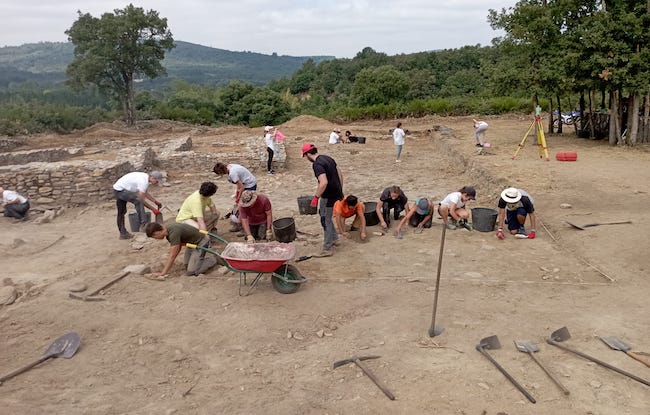
The archaeological team led by Xurxo Ayán is closer to completing the history of the Castro de San Lourenzo in Cereixa, A Pobra do Brollón, after completing what was the eighth excavation campaign at the site.
The campaign was promoted by the María Castaña de Cereixa Neighborhood Association with the scientific endorsement of the Institute of Contemporary History of the Nova University of Lisbon and the Institute of Heritage Sciences of the CSIC.
It took place from August 1 to 12 with the support of 11 participants from the fifth International Volunteer Camp, held thanks to an agreement between the City Council of A Pobra do Brollón and the General Directorate of Youth of the Xunta de Galicia.

A monumental quartzite wall
The main objective of the intervention was to expand the excavation area between the apse of the church and the wall. The team found the inner face of the wall, a monumental wall 4 meters high made with a foundation plinth and a slope structure with several differentiated sections. As a particularity, it is made of dry stone with quartzite copings, being one of the few examples in the northwest of the peninsula of castrexa walls made with this material.
Apart from the monumentality of the wall, which would have been 8 metres wide, its excellent state of conservation is striking. “Over the nine hundred years since it was abandoned as a fort until the arrival of medieval people, a series of clay and sand deposits were created that protected the wall, so there are hardly any collapses and it is really preserved intact,” explains the director archaeologist Xurxo Ayán.

A pre-Roman jewel
In addition to the wall area, part of castrex structures probably linked to the iron metallurgical industry were also excavated, a kind of fireplace with a base made of slab with holes. It was in the vicinity of these structures that 23 necklace or bracelet pieces appeared, some made of bone, others in what is probably glass paste.
“This is an exceptional find in the context of Galician castros. We probably have the entire piece and it is clearly pre-Roman, from the 2nd or 1st century BC,” Ayán comments regarding the jewel.

Knowing the history of life and death in the Castro
Regarding the site's more recent history, the medieval period, the team unearthed a series of children's tombs on the eastern edge of the San Lorenzo chapel, corresponding to the 12th century, just before the necropolis was abandoned.
Unlike other campaigns, hardly any bone remains appeared in the tombs, although charcoal was found that will help to date the burials more accurately. It is worth noting that materials from the Castres were reused in the construction of the tombs, such as the remains of barque-shaped mills and slabs.
The recovery of the history of the Castro de San Lourenzo was completed with the V Pilgrimage of San Lourenzo, an initiative linked to the archaeological project in which the tradition of carrying the San Lourenzo from the current church of Cereixa to the castro is recovered.
“We overcame the inertia caused by the pandemic to successfully celebrate this date, which is an essential part of the community heritage recovery work that we are doing in the parish,” says Xurxo Ayán.