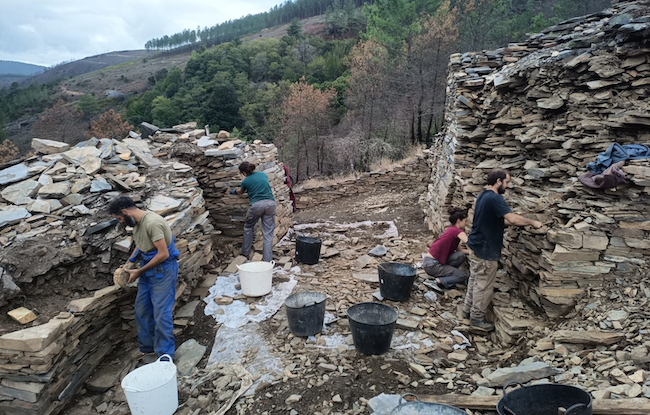
- The work is funded by the Department of Culture of the Xunta within the framework of the ‘village archaeology’ project Penas do Castelo.
- The forecast is that they will last a couple of weeks and that the area will be ready and conditioned for visits
In last year's campaign in Penas do Castelo, located in the parish of Salcedo, Municipality of A Pobra do Brollón, the monumental entrance to the site, dated to the transition from the Bronze Age to the Iron Age, was already located. In this year's campaign, the objective is to make both the entrance and the corresponding section of the wall open to visitors.
In the work prior to the restoration, carried out in recent weeks, the area was completely cleared. This small intervention confirmed an external entrance of 80 cm in width and a second one of 2.5 meters, of a much more monumental nature. Between both accesses, a closed intermediate space is generated that would act as a kind of trap, according to its researchers.
‘The structure has a great defensive logic, while the potential enemy is forced to pass almost one at a time through the first door, the occupants of the site could rush out from the second and make an effective defense,’ says Benito Vilas, archaeologist director of the Árbore Archaeology and Management cooperative.
The entrance is in keeping with the existing great wall, the first element that caught the attention of the site, due to its monumentality in relation to its antiquity. In the area of the door, practically 3 meters high and a thickness of about 8 meters are preserved.

Burnt door
Although the priority of the previous work was to prepare the space for restoration, the site held some surprises. Once the rubble from the entrance area was removed, a line of charcoal and reddened stones appeared that correspond to the burnt imprint of the old wooden door.
‘These remains are very interesting, as they can be analyzed using Carbon 14 to date the probable moment of abandonment of the site,’ says Benito.
Complex restoration
The restoration is very complex due to the monumentality and orography of the site itself. The general state of conservation is good, taking into account its age and, above all, the fact that it was built in dry stone, without any type of mortar.
‘Despite the good conservation, some areas remained buried. Now we will have to reinforce and consolidate those areas to prevent collapse,’ says Alba Losada, director of restoration.
‘The criterion will be minimal intervention, giving priority to conservation, preventive, guaranteeing the stability of the structure. It will be necessary to consolidate and create sacrificial rows, so that they act as a shield over the original structure,” he adds.
Village archaeology
This intervention is financed by the Ministry of Culture, Education, Vocational Training and Universities, which has invested more than €50,000 in the last three years; but the Community of Montes and the Salcedo Neighborhood Association as well as the City Council of A Pobra do Brollón also participate in the community project.
Through this collaboration, the site is included in the municipal guided tour circuit and information activities have been carried out within the framework of the Salcedo Cultural Week.
The territorial delegate of the Xunta in Lugo, Javier Arias, highlighted “the importance of knowing and rescuing our historical heritage, which is integrated into the identity of each town and is presented as a cultural element and a first-rate tourist resource.”.
For his part, the mayor of A Pobra do Brollón, Xosé Lois Maceda, comments that ‘it is a very interesting site for us, which complements very well with our other archaeological offer. Let's hope that next year we can continue with an agreement.’