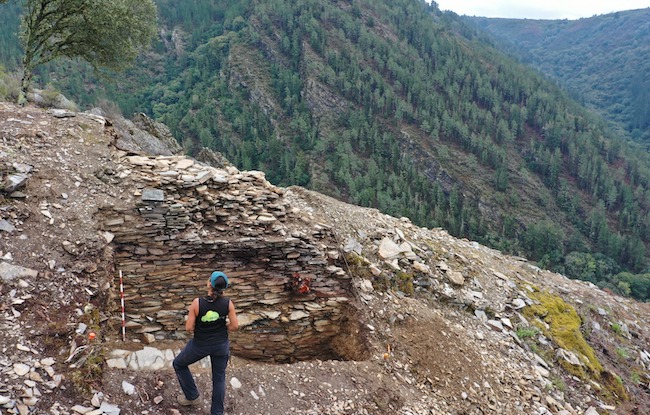
The first archaeological campaign in Penas do Castelo continues to yield unique and surprising results. This site located on the slope of the Río Lor in the parish of Salcedo, A Pobra do Brollón, was excavated last summer with funding from the Xunta de Galicia and the collaboration of the City Council, Neighborhood Association and the Comunidade de Montes.
The excavation uncovered a monumental wall six meters wide and up to four meters high. Since then, there has been much speculation among locals and specialists about the origin of this peculiar site.
Its monumental moats, dug into the rock, were reminiscent of those of other castros in O Courel and even sites such as that of O Castrillón in Larouco. On the other hand, its location entirely on a hillside with very little usable surface area inside and, above all, its enormous wall and a peculiar modular construction system, had baffled specialists.

During the excavation, soil scientist Cruz Ferro took soil samples ‘at key points during the construction of the wall’, she says. After being analyzed by Carbon-14 at the BETA laboratory in Miami, we can state that the dating results give VIII–IX century before our era. ‘The consistency of results between the three samples makes them highly reliable,’ adds Ferro.
A The originality of the site is due to the fact that it is an extremely early castro., so it is not comparable with the more ‘classic’ castros of later times. ‘This is reflected in the toponymy itself; it is no coincidence that it is called a castle and not a castro. For traditional society, this was not a castro like the one in A Roda, also in Salcedo,’ the team points out.
With this dating, Penas do Castelo is located precisely in what would be the transition from the Bronze Age to the Iron Age. This would be the time of the construction of the first castros in the northwest of the peninsula, that is, the moment when communities began to settle in a sedentary manner in the territory and to make permanent stone constructions.
‘We are at the hinge between a world of perishable structures, more than camp and a world of buildings to last, more than a village,’ summarizes Benito Vilas, archaeological director.
This is precisely one of the most interesting elements of the site, since beyond the location, it gains scientific interest because it is a historical period in the northwest of the peninsula that is largely unknown at the research level. Penas do Castelo can contribute to understanding the dynamics that cause the sedentarization of communities and the territorial tensions that this causes.
In this context, the location of the site does not seem coincidental since it is located in a territory of known mineral wealth. At that time, certain minerals such as iron would have been strategic and the control of their extraction and trade, fundamental for the communities. ‘We suspect that this fact may be behind the very atypical location, on a hillside, or the extraordinary size of the walls,’ the team comments.
New questions
The arrival of the results is a long-awaited answer that in turn raises new questions.
‘We have to understand that while this community is equipping itself with a six-meter-wide stone wall, in other places in Galicia they are still building with sticks, straw and mud,’ highlights Benito Vilas.
From the point of view of social organization, this fact may be an indication of a highly organized community, certainly with hierarchies and, above all, surplus time and manpower that would allow a civil work of this magnitude.
On the other hand, there is the technical knowledge involved in this construction. ‘It is striking that in this era, when the first stone walls were built, they built a wall six meters wide and with such refined technique. Where does that knowledge come from?’ asks Vilas.

New challenges
The site is also facing a new moment as a visitable site within the network of tourist resources of the Municipality of A Pobra do Brollón. ‘The commitment of the Municipality of A Pobra do Brollón to community archaeology as a strategy for creating tourist resources ’It is bearing fruit and these results will undoubtedly increase interest in visiting this site," says Xosé Lois Maceda, mayor of the Municipality of A Pobra do Brollón.
In addition, the result helps to bring the neighbors together around the site and the project, since it places Salcedo on the archaeological map. ‘In addition to the well-known Carnival and the Bear, Salcedo has other heritage values that we have to highlight,’ says Marisa Defente, representative of the Neighborhood Association and Montes de Salcedo Community. ‘It is very curious to see how the constructions of those first communities to settle in the territory, now help those who are perhaps the last communities to create identity and resources to continue sedentary.’
For the Ministry of Culture, the results are of great interest for research but also within the framework of the World Heritage candidacy, since they put us in contact with the first communities to settle definitively and permanently on these banks, with the consequences this has for the landscape.