The bones were discovered in May during an archaeological excavation in Vilachá de Salvadur, as part of the Adegas da Memoria project. The dating results are very interesting for understanding the origins and historical evolution of the Ribeira Sacra.
The dating results were presented last Friday, November 29, at an event at the Casa da Cultura in A Pobra do Brollón, with speeches by the mayor Xosé Lois Maceda, the president of the Vilachá Residents' Association, José Castiñeira, the archaeological director Xurxo Ayán and the coordinator of the Adegas da Memoria project, Xosé Gago.
The archaeological campaign at the site of Os Conventos, in Val do Frade (Vilachá de Salvadur) took place in May of this year within the framework of the Adegas da Memoria project. The campaign was financed by the City Council of A Pobra do Brollón and the Vilachá de Salvadur Neighborhood Association, with the participation of the Universidade Nova de Lisboa and Incipit-CSIC.

A campaign full of surprises
The objective of the campaign was to verify the existence of a primitive medieval monastery recounted in a legend of the residents of Vilachá and also cited in medieval documentation.
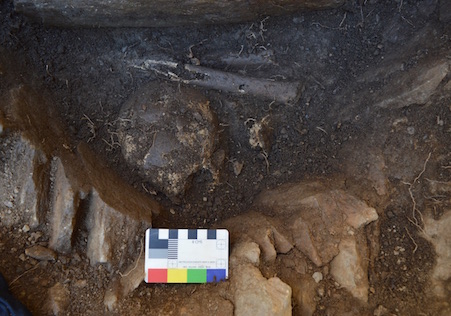
In the excavation, after verifying phases of occupation and medieval archaeological materials coinciding with the centuries indicated in the documents, towards the end of the campaign a strange burial appeared with a skull and several long bones, placed in a cist excavated in the rock and with evidence of combustion.
“The burial did not have a medieval appearance nor did it match a Christian burial,” says Xurxo Ayán, director of the excavation and researcher at the Institute of Contemporary History of the Universidade Nova de Lisboa.
After working with various hypotheses, the C-14 tests carried out at the Beta Analytics laboratory in Miami (USA) leave no doubt: these are remains from the 10th century.
“The result is very interesting,” continues Ayán, “since the remains belong to the period of the Dark Ages, about which we do not have much information; a time when Christian rites were different from those of today and were mixed with other types of pagan elements.”
This chronology corresponds to that of the hermitages, which preceded the great monasteries and were regulated by the rule of San Fructuoso. “These remains have to do with the use of the riverbank as a symbolic space. In Os Convents we certainly have a sequence in which a primitive hermitage gives way to the monastery of San Martiño de Piñeira.” In the Cistercian era it seems to have been constituted as a farm, a productive unit, the riverbank having already consolidated itself as an economic space.
Opening a path to the Ribeira Sacra hand in hand with the local community
The find is of great value for understanding the origins and evolution of the cultural landscape of the Ribeira Sacra, as well as for what it means for the parish and the residents of Vilachá.
“Vilachá, located on the outskirts of the Ribeira Sacra is becoming the center of scientific and historical knowledge of this territory,” says Xosé Lois Maceda, mayor of A Pobra do Brollón. “This is thanks to the involvement of the parish residents themselves, who are involved in the project.”
The coordinator of Adegas da Memoria and culture and tourism technician of the City Council, Xosé Gago, declared that the project is opening a path at a crucial moment for the Ribeira Sacra. ‘A path with a scientific basis and counting on the involvement of the residents, who are the ones who really make the Ribeira Sacra with their work and daily effort.’.
A new archaeological campaign is expected to be carried out in May 2020 to continue delving deeper into Os Convents – in which there are already indications of more burials – and therefore, into the history of the Ribeira Sacra.