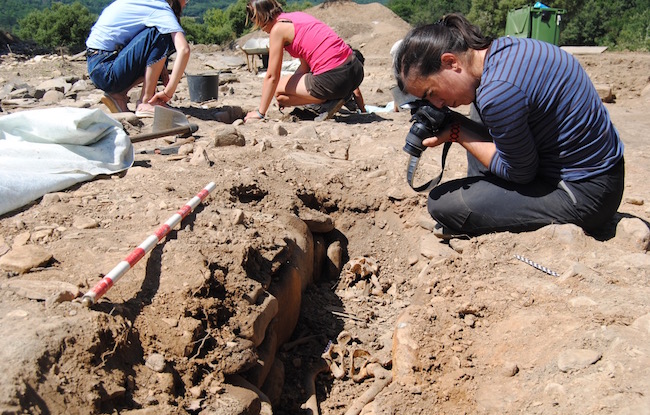
A practically complete skeleton in a very good state of preservation has been found in the excavation at the Castro de San Lourenzo, in the parish of Cereixa in Guimaras. It was towards the end of the archaeological campaign, which began on July 15 and ended on Thursday, August 15. The campaign was promoted by the parish's neighborhood association, the A Pobra do Brollón Council and the Universidade Nova de Lisboa, with the participation of an international work camp subsidized by the General Directorate of Youth of the Xunta de Galicia.
‘Murphy's law is relentless. We had been campaigning for almost a month. But it is always in the last days of a campaign when the most spectacular things happen,’ says Xurxo Ayán, archaeological director and researcher at the Institute of Contemporary History at the Universidade Nova de Lisboa.
Under Ayán's direction, the team of three archaeologists, an anthropologist, and 17 field participants was excavating a medieval church and necropolis within the fort's grounds.
On the north side of the remains of the medieval church was the monumental tomb of the skeleton. These remains join those of the famous Atilano from last year's campaign, but the new individual is much better preserved; the bones are more complete and will provide more information.

Bones full of data
The skeleton was found in a slab tomb, without filling it with earth. ‘In this type of tomb, an empty space is created that favors the preservation of the remains,’ explains physical anthropologist Candela Martínez. When the first slab was lifted, a perfectly preserved skull was already visible, including teeth.
Other preserved bones are the coxae (from the pelvic area), which together with the skull allow us to define the age and sex of the individual, although at the moment it is too early to assess it. Martínez makes a very cautious assessment based on a first observation of the bones in which he comments that it is possible that the skeleton is that of a woman.
The dentures provide crucial information about diet. ‘With the analysis of stable isotopes, we can find out the diet that the individual had in their childhood, based on whether they consumed more fish or meat protein. This gives clues to the person's origin,’ explains Martínez. At first glance, this denture shows a lot of wear, which may be due to various factors such as age or diet. To have more accurate data, we will have to wait for the laboratory results.
Other data provided by the bone remains are related to the age range, pathologies that left a mark on the bones and the individual's quality of life, in addition to being able to obtain a very precise dating of the time in which they lived, through Carbon 14 analysis.
Regarding the dating, at the moment what can be said is that the remains certainly correspond to the early medieval period. ‘Due to the type of tomb and the archaeological context we are talking about between the 8th and 12th centuries, rather the 11th or 12th’ declares Xurxo Ayán. We will have to wait for the results of the laboratory analysis to have precise data.
Context: The Castro de San Lorenzo
The Castro de San Lourenzo is a Roman mining fort that was reoccupied and vacated on successive occasions in the Middle Ages as a religious center. The fort has a strategic location with great visual control over the surroundings and in the middle of the Jacobean route of the Winter Way.
This archaeological campaign is the fifth campaign to be carried out in the castro. In addition to archaeological research, part of the project involves the recovery of the memory of the place. This meant the recovery of the pilgrimage of San Lourenzo: a day, August 10, which has become an obligatory annual event for the residents of Cereixa, the City Council and other surrounding parishes.